Sunday, April 8, 2012

Pasqua and Pasquetta: The Twin Traditions of Sicily

Marzipan Paschal lamb
Easter, called Pasqua in Italian (derived from the Latin Pascha and Hebrew Pesach), is one of the most important holidays in Italy.

I have read that early converts to Christianity celebrated Easter every Sunday, causing discord among Christian communities of the time. In 325, the First Council of Nicaea, a meeting of bishops representing the Christian world, decreed that Easter would be celebrated the first Sunday after the full moon, following the Spring Equinox. Later, in 525, it was decided that the dates were to fall between March 22 and April 25. The 40 day period before Easter is one of fasting and atonement, beginning with Ash Wednesday and ending with Holy Saturday.  

Starting on Good Friday, the church bells in all of Italy are silent in remembrance of the crucifixion
and death of Christ.  Children are told that all church bells are turned toward Rome, and that they will turn back on Easter Sunday when they ring out joyously for the resurrected Christ.


 Perugina  hollow chocolate egg
Easter Day in Sicily is one of the most important food events of the year. In addition to attending church services, families prepare their most special meals and sweets. Traditionally Sicilians eat a main course of roast lamb for Easter dinner, along with a menu of baked pastas, marzipan or chocolate based sweets and other specialties


pastry wrapped Easter eggs
The tradition of colored Easter eggs wrapped in pastry baskets and marzipan sweets shaped like lambs, called agnello Pasquale di martorana, are among the things I love most about the holiday. Italian chocolate Easter eggs are especially wonderful, and in Italy the hollowed eggs are filled with a “surprise”. Depending on how much you are willing to spend on Easter eggs,  the surprise can be quite significant!  Once, as a child I remember getting an orange watch in my chocolate Easter egg surprise! Some specialty pastry shops prepare custom hollow chocolate eggs filled with unique gifts.  I have heard of  young women receiving  engagement rings in their chocolate egg--and can only imagine their surprise! 
The surprise!
The day after Easter, called Pasquetta in Italian, is an equally important holiday and a much anticipated ritual for all Italian families. Pasquetta falls on the first Monday following Easter Sunday.  On that day, Italians head for the countryside or seaside, away from the cities. They celebrate the renewal of the holiday and spring with family picnics and open-air barbecues.  This holiday commemorates the apparition of Christ to his two disciples on the country road leading to the town of Emmaus.  It is one of the most charming traditions of Italy and the succulent foods of Sicily make it even more anticipated!

Auguri di Buona Pasqua and a very happy Pasquetta to everyone!
Ciao a presto!

Saturday, March 31, 2012

The Sicilian Woman: Not To Be Underestimated


Maddalena and Vincenzo  Sciacca,  Erice 1957
Inspired by the conversation between Michael Corleone and his bodyguard Fabrizio, my husband, a second generation Russian-American, asks the perennial question to every Sicilian man he meets: Why are Sicilian women more dangerous than a shotgun?!    I’m afraid I don’t have an answer, and frankly the question is loaded (no pun intended.)  More importantly, the fact that he even asks that question attests to how much California life has mellowed this born and bred Sicilian woman!

Women have always been the backbone of the Sicilian family (and for that matter any family). But there is a particular quality to Sicilian women that embodies strength in times of hardship-- without loss of vulnerability--what Carl Jung described as maintaining a connection to the anima.
Nonna Maddalena Bavetta

 My mother’s name Maddalena is of biblical origins, meaning “tower of strength”. In retrospect, her parents could not have guessed how deeply apropos the name would be. She was named for her paternal grandmother, Maddalena Bavetta , a no-nonsense, strong-as-flint matriarch, who, beginning in 1900, crossed the Atlantic some 4 times to visit her sons in America—a virtual frequent flyer of the Italian Line of the Transatlantic!  Her final  solo crossing back to Sicily came at age of 82!  She lived another 10 years in Trapani with her son, (my grandfather) Leonardo and his family.

Maddalena and Vincenzo's wedding day
July 12, 1958

Born in the town of Sciara, in the Province of Palermo, my mother grew up in the port city of Trapani, a province of western Sicily.  Her father, a conductor for the Italian railroads, who moved his family frequently when they were young, eventually was awarded a post in his native Trapani.  The family lived in a flat at the  picturesque foot of Mount Erice.  My mother, the second-oldest in her family, virtually raised her three brothers with the velvet fist of a strong older sister.

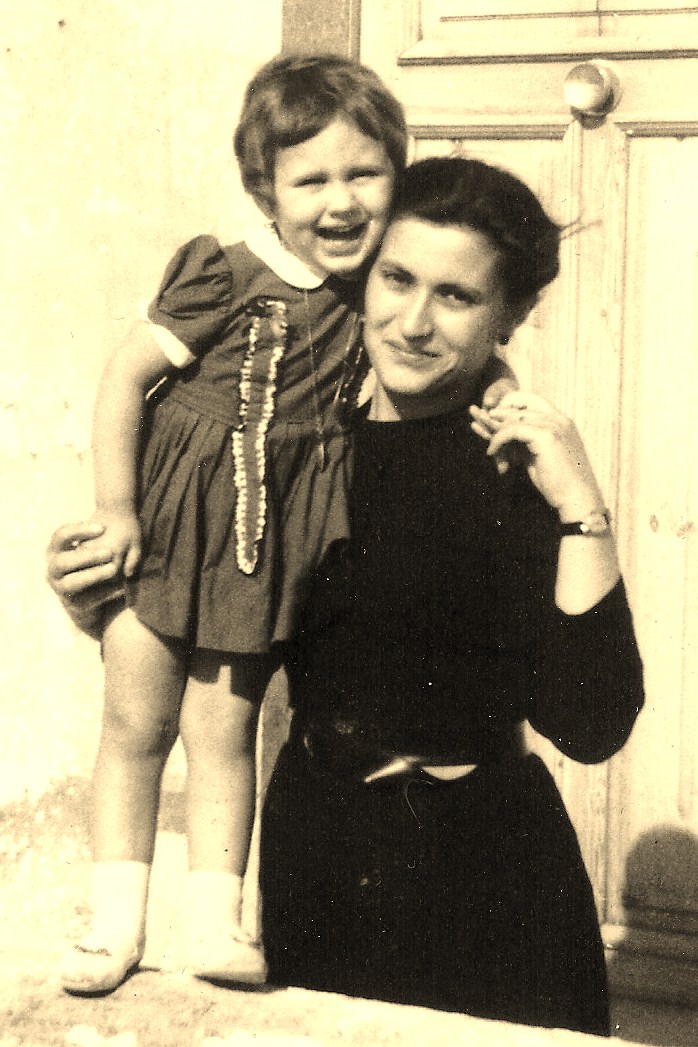
With my mother in Sicily 1963
Publicly shy, she met my father Vincenzo, a dashing young man from Marsala, at a wedding when she was 18.  He, charismatic and hard-working, with dreams of helping to rebuild the postwar Italian state, was struck--as if by lightening--when he first laid eyes on her!  From that auspicious first meeting however, the archetypal Sicilian story of love and loss began to unfold.  My mother and father married on July 12, 1958 and two years later on November 5, 1960, my father died tragically in an accident while driving a Vespa.  That single event, changed the course of my mother’s life (and mine) forever. 
Maddalena with her
step-grandson Peter Volkov


Tragedy does not bend Sicilian women. Because of the harshness of our  island’s history, (or perhaps in spite of it), collectively there exists in the Sicilian woman, a reservoir of great creative energy that reveals itself in times of need. My mother, Maddalena, is a vivid example of that.   Armed with  little more than her extraordinary artistic talent, a deep love for her family, and an ever-renewing source of creative spirit, she found her place in the American dream-- through the sum of her own effort.  Her legacy to her six grandchildren is one of pure love …and a model of raw strength and determination!

Ciao a' presto!
Mom today boxing!

KO!

With trainer Ken Eldridge


Thursday, March 22, 2012

Sicilian-American Rum Cake and The Migration of a Recipe

Francesca Vultaggio
Bilello and Michele Bilello
The subject of migration is inescapably tied to the foods and recipes each culture brings with it. Those recipes often change when they reach a new shore, yet there appears to be a kind of collective understanding that leads us to evolve our recipes in similar ways. This phenomenon never fails to amaze me.  I was recently asked by a reader about a cake she remembered from her childhood.  I  recognized it as something I had known in my family too. In fact, many Sicilian-Americans have a similar recipe in their repertoire.
This particular cake recipe comes to me from my great aunt Francesca Vultaggio Bilello of Marsala, whom we called Zia Ciccina.  She immigrated to the United States in1910, through Ellis Island at the age of 15.  Some 60 years later, Zia Ciccina welcomed me and my family to California.
A charming story exists about the 4ft. 9in.Ciccina .  She met her husband, Michele Bilello in Sicily.  A tall handsome man, Michele had immigrated years earlier, and he returned to Sicily to meet, for the first time, his future bride--Ciccina's sister!  The story goes that when he first laid eyes on Ciccina, he was hopelessly smitten. She followed him to America at the age of 15, and lived with relatives in South Bend Indiana, until they married two years later! Ciccina ran the family's Italian grocer store which was located in San Diego's Little Italy district for many years. They were married 64 years!

It is my belief that this recipe developed as an attempt to duplicate the cassata of Sicily.  The ricotta filling of the cassata, which may have been difficult to buy commercially at turn of the century America, would have been replaced with pastry cream, and the bits of chocolate in the ricotta, melted down to form a double layer of vanilla and chocolate filling.  In this version, the layers of chiffon cake are moistened with a rum wash, similar to cassata.  Crushed  pineapple and pitted cherries are added. (Both can be omitted or substituted with fresh berries, however I suggest you try the recipe as described because it is delicious).


Zia Ciccina's  4 Layer Rum Cake  (Francesca Vultaggio Bilello 1893-1972)

The Cake
Step 1:To make the chiffon cake layers, sift together the following dry ingredients in a large bowl:
2 ¼ cup cake flour;   1 ½ cup sugar;  3 tsp. baking powder;  1 tsp. salt

Step 2 :Make a well and add:  ½ cup light vegetable oil;  7 egg yolks unbeaten (reserve the whites); ¾ cup cold water; 2 tsp vanilla extract; zest from 1 lemon.

 Step 3: Beat the ingredients with an electric mixer until the batter is smooth.

 Step 4: In a separate mixing bowl beat until stiff, the egg whites with ½ tsp. cream of tartar and gently fold the batter into them until homogeneous.

Step 5: Pour the mixture into a greased 10 inch tube pan. Bake in a pre-heated oven at 350 for about 50 minutes. Use the toothpick test to determine if it is ready.  Slice the cake into 4 equal layers or discs after it is cooled.

(You can also make this cake square. I suggest you double the recipe and use four  9x13 inch jelly roll pans lined with parchment paper. Bake in a pre-heated oven at 350 for about 20 minutes. Check with toothpick .)

 The Pastry Cream Filling

Step 1: In a medium saucepan bring to a simmer  4 cups milk and  ½ cup sugar. 

In a separate bowl, whisk together 4 egg yolks with ½ cup sugar;  2 tsp vanilla extract; and a pinch of salt.  Add ¾ cup cornstarch, in small quantities to avoid lumps and whisk well as you add . Place this mixture on top of a double broiler. Continue whisking as you slowly add the heated milk in a steady stream to the egg yolk mixture .  Continue cooking on the double boiler until it thickens, about 10 minutes.

 Step 2: While still hot, set aside half of the pastry cream and add  about a half cup or more of semi-sweet chocolate bits to it , enough to turn it a rich chocolate color. Stir until the chocolate melts and is incorporated into the cream. Let both the vanilla and chocolate pastry cream cool completely.

 Step 3:  When the vanilla cream has cooled, add to it about a cup of chopped pitted cherries packed in light syrup and a cup of crushed canned pineapple.  Reserve the pineapple liquid to make the rum wash.

 Assembly

Step 1: Begin with the first layer of your cake and brush or sprinkle it with the rum wash, made of half a cup of rum and half a cup of the reserved pineapple  juice.  Spread the vanilla pastry cream evenly on the cake layer.  Place the second layer of cake on top of the first and again brush it with rum mixture and spread the chocolate pastry cream on it. Do the same with the third layer and stop at the fourth layer. 
 
Whip one pint of heavy cream with powered sugar to taste until thick. Spread the whipped cream over the entire cake.  Add toasted slivered almonds to the sides of the cake. With regard to decorating the cake, I have followed my mother's lead in this and always decorate this cake simply with fresh flowers or berries. Keep this cake well refrigerated until serving

Buon appetito and ciao a' presto!


Wednesday, February 15, 2012

San Valentino: Patron Saint of Lovers

The story of San Valentino originates in Roman antiquity.
San Valentino a Christian martyr from what is today Terni, was born in 176.   A convert to Christianity, he was ordained a bishop in 197, during a time of Christian persecutions and the expansion and defense of the Roman Empire. His growing popularity and conversions of non Christians, threatened -or possibly just annoyed- the roman rulers and he was eventually executed at the order of Emperor Lucius Domitius Aurelianus in 273 during one of his stays in Rome 
S.Valentino as Martyr
The legend surrounding San Valentino says that during one of his incarcerations, he was given in custody to a noble family who had a young daughter who was blind. Later, at the time of his beheading, San Valentino was said to have performed the miracle of giving the young girl her sight. He is commemorated every February 14
If this sounds to you as it does to me, like a tender almost paternal love, radically different from the associations we have of Valentine’s Day today, you are correct.
In fact, the legend of San Valentino is thought to have been overlaid by the Catholic Church on an ancient pagan fertility ritual Lupercali. Associated with the Greek god Pan, Lupercus’ priests wore goat skins and made animal sacrifices to ensure  the health and prosperity of their followers. It is believed that until the 4th century, non Christians of Rome celebrated this annual feast, much to displeasure of the growing Catholic Church..
Protector of lovers
I have heard many stories associated with  the Lupercali, but cannot vouch for their veracity. The story I like best however, fictitious as it may be, says that the names of young men and women who were devotees of  Lupercus, were placed in an urn  and chosen randomly by a child to live together  for an entire year until the fertility ritual was concluded  ( I assume with the birth of child.)  Wanting to put an end to this practice the Church promoted its own patron saint of lovers, San Valentino who had been martyred some 200 years earlier.
In Sicily, the feast of San Valentino is celebrated much more in recent years than when I was growing up when it was much less commercial.
On this feast of San Valentino, in addition to the endearing expressions and beautiful red roses from my darling husband, a familiar pair of love birds returned to our lagoon the morning of February 14.  An omen no doubt from San Valentino and his alter-ego Lupercus, for  love, health and prosperity for the rest of the year!
Auguri per la festa di San Valentino!
Ciao a presto!

Tuesday, February 14, 2012

Pasta Al Forno --Part 2: The Recipe


In his extraordinary book, Sicily Culinary Crossroads, legendary Sicilian  historian and food writer, Giuseppe Coria, states that a cohesive Sicilian gastronomy does not exist because of  variation among towns and regions, owing to a history of foreign domination, geography and climate. Pasta al forno is an example of this, with its many variations throughout the island. The recipe below is one taught to me by my beloved aunt, Zia Pia from Marsala, and it will delight your family and guests as it does mine. 


Ingredients:
-1 medium red onion; 250 grams (or ½ lb) each of ground veal and pork; 4 T olive oil
-1 liter (about 5 cups) of pureed tomato;  200 gr (or ½ c) each of pine nuts and dried currants;
 450 gr (or 1 lb) shelled peas
-A small whole red chili pepper; salt; sugar and freshly grated nutmeg to taste; fresh basil
-500 gr (or 1 lb) fresh sheet pasta
-Caciocavallo cheese (about 10 thin slices); 250 gr (or 1/2 lb) grated pecorino cheese
-Butter for greasing the casserole dish and a few tablespoons of unseasoned breadcrumbs

The Ragu:
If you are making your own tomato puree, which I recommend you do,  begin by boiling about 5 lbs of ripe roma tomatoes and passing them though a food mill that captures the seeds and skins. Discard the seeds and skins and set the puree aside. Soak the currants in hot water to soften and set aside.
 Sauté a finely chopped onion in olive oil until translucent.  Add the ground beef and pork and continue browning over a medium flame. Add the tomato puree, pine nuts and currants. Season with salt, whole red chili pepper, a tablespoon of sugar to taste, a dusting of fresh nutmeg and a handful of fresh basil.  Cook the ragu for about an hour on a low flame, stirring it occasionally and allowing it to thicken. At the final cooking, remove the chili pepper and add the peas. Remove the sauce from the heat and set it aside.
Note: A tomato extract, called ‘strattu is used to thicken and flavor Sicilian red sauces. ‘Strattu is made by drying tomato pulp in the sun on wooden boards and is almost impossible to come by outside of Sicily, unless it is home made. Commercially bought tomato paste is not the same and will alter the flavor of your sauce, so I have omitted it here.  Using a simple tomato puree, your sauce will thicken as it reduces, and the flavor will capture the sweetness of fresh tomato.                                      
                                               
                                                   The Pasta
You will need about a pound of fresh sheet pasta, like the kind used for lasagne.  If making the pasta at home, make the sheets very thin. Most cities now have fresh pasta manufacturers. I divide my time between the two coasts, and when I'm in San Diego I go to Assenti Pasta http://kekova.ca/page/contact ; in Washington DC, Vace Pasta www.vaceitaliandeli.com.   Cook the pasta al dente in batches, in boiling salted water and transfer it to a container of ice water to stop the cooking. Next remove it from the ice water and lay the pasta flat on a clean dish cloth, making sure the edges don’t touch. 


Assembly
You will need a casserole dish or cake pan with tall sides, approximately 8x3 inches, which can be found at  http://www.fatdaddios.com/.  Grease the pan with butter or olive oil and coat the sides and bottom with breadcrumbs.  Begin by placing the cooked pasta sheets in the pan making sure they completely cover the bottom. This first layer only must hang over the sides of the pan.

Add  a generous  ladleful of ragu on the first layer, followed by  a few slices of caciocavallo cheese, and a dusting of pecorino. Caciocavallo is now available in may import stores, but if it is not available, it is fine to just use pecorino.  (At this point the classic ingredients of pasta al forno-- sautéed eggplant, sliced hard boiled egg and salami or mortadella would be layered in--however this particular recipe does not call for them.) Continue layering the pasta, sauce and cheese until you reach the final strata. Finish the layering by taking the overhanging sheets of pasta and bring them gently upward toward the middle so that your casserole resembles a cake.  Place it in a hot oven.

 Cooking
Bake the pasta uncovered in a preheated oven at 375 degrees for about 40 minutes. Allow it to brown on top and remove it when it is bubbling hot.  Cool the pasta for about 20  or 30 minutes.
Place a large flat dish on top of the pasta and carefully invert pan so that it is sitting face down on the dish. Gently tap the top to loosen the pasta and remove the pan, being careful to keep the pasta intact. 

Slice the pasta in wedges and serve it as a first course accompanied by hearty red wine.


Buon apetito and ciao a presto!

Sunday, February 5, 2012

Pasta Al Forno: The Exquisite Baked Pasta of Sicily--Part 1


Pasta al Forno

Pasta al forno is by far one of the most impressive dishes of Sicily. There are as many nuanced versions of this baked pasta as there are regions in Sicily. This is an elegant dish, most often served on Sundays or at holiday meals.
One of my favorite and funniest movie scenes of all time is the unmolding of the timpano of baked pasta in The Big Nightttp://youtu.be/hn8_eKy3PdE

Anyone who has ever made pasta al forno, or any molded Sicilian baked pasta, knows what that’s all about.  The anticipation is palpable as the sum of all your effort hangs on a string—one wrong move and your oeuvre implodes in a messy heap on the serving plate! Even my husband recently confided to me that watching pasta al forno being unmolded makes him a nervous wreck!  
The ragu

Pasta al forno is essentially a richly seasoned pasta that is baked in a molded pan. Pasta of any shape may be used but it is most commonly made with short pasta such as anelletti or penne.  
The pasta is cooked and then tossed with ragu.  Then it is transferred to a deep, round, molded baking pan called a timpano or drum, which has been oiled and dusted with bread crumbs. It is arranged in in the timpano in alternating layers  of pasta, sautéed eggplant, caciocavallo or pecorino cheese, sliced hard boiled egg, and sautéed sausage or mortadella followed by more ragu and pasta. It is baked in the oven, cooled, and served unmolded.

The flavors of pasta al forno
The ragu itself is very richly spiced with ground beef, raisins, called sultanina, peas, pine nuts, and nutmeg. The element of surprise of the varied textures and flavors is especially pleasing.    The result is  an elegant structured pasta that looks much like a torte, and in fact it is sliced and served in wedges like one. Your guests, I will promise you, will be impressed.


Pasta al forno is sometimes referred to in Sicilian dialect  as  pasta ‘ncasciata.  I’m told that this is a reference to the  cacio cheese that is used, although I find it curious that the Sicilian word “incasciare” also means to press something down, as for example into a mold or box. This pasta is a great dish for entertaining because it can be prepared in advance, even frozen, and it reheats beautifully. I always try to keep one or two in the freezer in the event of unexpected company.

Zio Tannino and Zia Pia
In part 2 of this blog I will share with you the recipe for a pasta al forno from my region of western Sicily. I learned to make this particular version from my aunt Pia, whose pasta al forno is without question the best I’ve ever had.  Zia Pia is my late father’s youngest sister and growing up I spent as much time in her house as I did in mine …and still do whenever I am in Sicily!  
Zia Pia’s recipe varies slightly from traditional baked pastas, because it's made with sheets of  uncut pasta, and  does not include eggplant or hard boiled egg or sausage. She often refers to it as millefoglie or  "thousand layers" because the layering of pasta sheets is so delicate and numerous that it resembles pastry. The result is truly extraordinary!

With my Zia Pia on her balcony.


My aunt and uncle have a summer home on the beach at San Teodoro in  Marsala.  It is the very beach we went to as children and it has many important memories for me. Summers at my aunt's home are a constant coming and going of family and friends. Over the decades, her modest patio dining table has provided heavenly gastronomic experiences to an untold number people from far and wide. Her culinary abilities, and most importantly her loving nature are recognized in our entire family as a true gift, which we all get to partake in.
Join me for Part 2 of this blog to see how Zia Pia's pasta al forno is made.  Until then,
Ciao a presto!


Sunday, January 22, 2012

Buona Domenica: What's Cooking Sunday?


Meal scene from The Big Night

Sicilians like most Italians, love Sundays.  Saturdays are often work days for Italians, so Sundays are a true day of relaxation and always festive. Meals are more formal than the rest of the week, often shared with guests or extended family.  The day unfolds in a cacophony of chatter and laughter; fragrant kitchen aromas mix with the sounds of cooking, and the unmistakable feeling of something special in the air. One of my favorite Italian singers, growing up in Rome, was Antonello Venditti, whose song Buona Domenica really captures the mood of the day. You can listen to Buona Domenica           at:  http://www.youtube.com/watch?v=mx4I2ZdLaPE

Special dishes that require longer preparation or more expensive ingredients wait for Sunday, and in our home, dessert is always served on that day. Fresh flowers were purchased for our home every Sunday, a custom which I continue to this day.

On Sundays, typically, someone is assigned the task of picking up cannoli or other dessert such as cassata, a Sicilian sponge cake made with ricotta, marzipan, candied fruit and liqueur.  These are purchased from bakeries that are part of coffee bars.  Pastries are packaged with elegant paper and ribbon and have the festive look of a gift.


Cannoli from Bar Erice

In Sicily, cities and provinces, not to mention coffee bars bakeries, compete to make the best pasties in their region. In Trapani for example, the consensus is that best cannoli come from Bar Erice, in the small suburb of  Napola.  Along with its neighbor Dattilo, these two suburbs produce ricotta-filled cannoli of  leviathan proportion considered to be the best—certainly the largest--in western Sicily!  

Sundays hold another childhood memory for me as well—that of television programs of the state owned television and broadcast company, RAI.    The custom among Italian families prior to the late 1970’s, was to go on family outings on Sundays, often to the countryside. The oil embargo and economic downturn of the late 1970’s had a big impact on Italian lifestyle; the government sought to impose austerity measures, and television became a vehicle for accomplishing that. By providing up to 6 hours of continuous programming, a novelty at that time, the government enticed families to stay home and thus conserve gasoline.

The ad for Carosello reads:
"go to bed after Carosello"!
 My favorite childhood program, called Carosello, was broadcast daily from the late 1950’s to the late 1970’s. It  came on at 8pm and was a half hour program consisting of a series of product commercials. All Italian children knew that when Carosello was over, it was time to go to bed!   Done as vignettes or sketches in the style of musical theater, often comical or whimsical in nature, they now remind me of a tamer version of  TV commercials that appear for the Super Bowl.
   
 
In 1976, a variety and entertainment program called Domenica In was developed, with Corrado Mantoni at the helm, who is known in Italy simply as Corrado.   Domenica In helped launch many of Italy’s legendary television personalities and entertainers including the much beloved Pippo Baudo and is still on air today.  In 1985 an alternative to Domenica In, called Buona Domenica was developed and remained on air through 2008.  


So as you wind down your Sunday and cheer on the NFC champions
GO GIANTS!!!!

...I wish you all Buona Domenica ….and ciao a presto!